
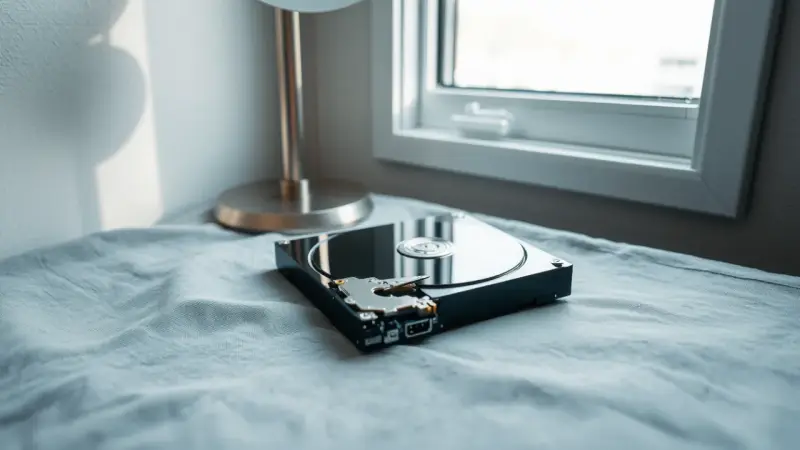
On 10 August 2010, Toshiba announced Wipe, a feature for its self-encrypting drives (SEDs) that makes the data on a hard drive unreadable once the drive is powered down. The company said the feature could also be used to erase data before a drive was disposed of or repurposed.
Toshiba’s statement described the technology as invalidating the drive’s security key when the power supply is switched off. The company described this as the world’s first ability to erase sensitive user data automatically at power-down or when a drive is removed from a system.
What Toshiba announced
Wipe was created as an enhancement to Toshiba’s SED hard drives. Those drives are built to the Trusted Computing Group’s Opal specification, which provides access security and on-board encryption for client systems such as notebooks. Toshiba had announced its latest 2.5-inch, 7200rpm SED model in July 2010, and Wipe was to be included on that drive.
Toshiba said Wipe could also be used before a leased system was returned. It could set data-invalidation attributes for multiple data ranges, so a system designer could choose which parts of a drive were protected.
Toshiba gave no timeframe for the feature’s arrival in future SED versions. It expected the drives to go into laptops and desktops. Beyond PCs, it targeted copiers and printers, which store images of the documents they handle. Toshiba noted that organisations increasingly recognised that data at rest had to be secured on those devices as well.
How it worked
Wipe did not overwrite the stored data. Tom’s Hardware pointed out in 2010 that the data was not literally deleted. When power was cut, the key that had encrypted the data was invalidated, and without it the contents could not be read. This is the process known as cryptographic erase.
That differed from the software approach common at the time, in which tools such as Eraser overwrote a drive while the system stayed running. Depending on the method and the drive’s capacity, overwriting could take hours. A key-based approach removed that wait, and Toshiba said it removed the need for overwriting software or physical destruction of a device.
The feature depended on hardware modules inside the drive. For copier and printer makers, it meant document images could be invalidated automatically without operator action.
What happened next
In April 2011, Toshiba announced Wipe2, according to the company’s own white paper on the technology. That paper describes the Wipe family as a set of enhanced features for TCG-Opal SED models. It says protected areas are cryptographically erased whenever system power is turned off, which would stop someone recovering document images from a copier that had been stolen, scraped or returned to a leasing company.
Computerworld later described Toshiba’s self-erasing drives as using AES 256-bit encryption plus a proprietary wipe technology enabled by the Opal specification. It listed four levels:
- Wipe 0: standard ATA Security and TCG-Opal data invalidation commands.
- Wipe 1: protected data ranges invalidated at every power cycle.
- Wipe 2: protected ranges invalidated if an uncertified host is connected.
- Wipe 3: protected ranges invalidated if the drive receives multiple invalid unlock commands.
The technology also went through formal certification. A NIST FIPS 140-2 security policy covers the Toshiba Secure TCG Opal SSC and Wipe Technology self-encrypting drive series, models MQ01ABU050BW, MQ01ABU032BW and MQ01ABU025BW. Among the services it lists are hardware-based data encryption, cryptographic erase and secure automatic data invalidation, the last of which is provided by Wipe.